|
10.
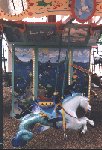
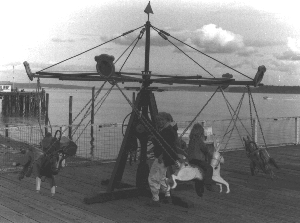
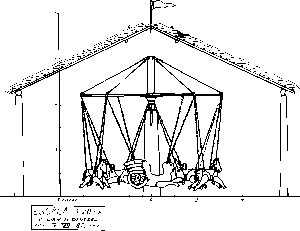
Wooden Centerpole "Flying Horses" Carousel set up at Van Cortland Manor
in Croton-On-Hudson, New York. Operated in the fall by Historic Hudson
Valley Association at the Great Jack-O-Lantern Blaze. (items for sale) Possibly the last carousel to be made in Port Townsend at the Dentzel
carousel workshop.
(2017)
Description:
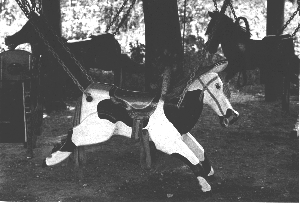
wooden centerpole, sweeps, animals, chariot,
swing seats, ring catching game, operated by hand and optional electric
motor, carries a total of 15 riders, 2 on chariot, 8 on animals and 5
more on swing seats. See photos of it before completion of panels on
site and shipment
"Flying Horses" Mechanism (no longer) For Sale .
MGR #10 Spinning 2017 on Hudson River NY
MGR #10 Stopped 2017 on Hudson River NY
Several
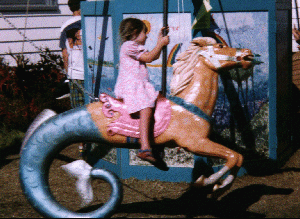
menagerie animals and a chariot are on this mechanism as well as spaces
for five swing seats, buyer can also
choose or make two more animals. Light weight scenic panels and other
decorative panels are included, these work fine and can be used to make
heavier panels at a later date. This new but
old style carousel is 20 feet in diameter and 12 feet
tall, it
carries 10 to 15 riders. It must have 24 to 36 foot diameter pavilion
to protect
from weather. The sturdy design will last indefinitely, very low
maintainence. See Inventory of parts for MGR #10.
|
|
9. Lenny and Joe's Fishtale Drive-In, Madison,
Connecticut (1999)
A family and community in New England using the
carousel to
raise money for local charities.
Either Lenny
or Joe
discovered the original Dentzel
carousel website in 1997 and saw the possibility of adding a nice
little carousel to their very popular Long Island Sound fish restaurant
campus. Of course, as always, periods of wait and consideration
had to run their course until late 1998 when one of these wonderful and
industrious restaurateur brothers made the call to order a
carousel. This put the design and building process at the Port
Townsend Dentzel workshop into the production mode; steel fittings,
centerpole, animals, lobster chariot, hippocampus,
110 volt electric motor drive-train, scenic panels, lights, were now
moving
through various lists and work stations. Fortunately Lenny and
Joe chose to use several animals which were in inventory which relieved
some of the pressure to get the carousel up and running in Madison by
Memorial Day 1999, only months away.
After a winter
and spring
of carousel construction Bill invited Michael Levine, a local Port
Townsend astronaut, to be his co-pilot in the big ugly (1978 E250) van
and utility trailer rig filled with animals, mechanism, and scenics
plus the painting program kit. The drive from Port Townsend to
Madison was close to 3000 miles, which included a snow storm in Wyoming
and a touch of Paradise at Jim and Jane's southeast Iowa wilderness
hangout. Jim Spring, a well known bird artist, took up the offer
to follow along to Madison CT to paint the shields (with local bird
species of course). Arriving in Madison, Lenny and Joe
generously put us all up at the centuries old Dolly Madison Inn.
Here all of the halls and floors were crooked and the ceilings easy to
touch with your hands over head even for short people. The lobby
was actually a very well stocked Yankee bar at least 100 years old,
right on the other side of the entry foyer was a comfortable family
style gourmet restaurant. The most we ever used this area was for
the big Sunday breakfast, otherwise Lenny and Joe gave the carousel
crew a free meal ticket at their fish drive-in, this is a first class
drive-in with a big menu.
Four weeks of
assembly
and painting burned up most of the energy gained by the big Long Island
Sound fish meals served at the drive-in (scrod fish and chips, Rhode
Island clam chowder, soft shell crab, coleslaw, onion rings, baked
potatoes, lemonade). Local carousel expert painter and historian
Donna Woolcott, a friend of Lenny and Joe's, was keen to join in
on the assembly and painting project taking place at the little
restaurant park. Donna meticulously went over all of the animals,
and continued to do so for years afterward, to give them their truly
magical glow. Kids and seniors helped paint the carousel's scenic
panels, Jim did beautiful local wildlife birds on the shields, and
Bonnie and Steve drove out from McMinnville, TN to help paint the
animals. Bill had to make a small but difficult modification to
one of the carousel drive parts, fortunately the new heavy duty rollers
needed were available nearby in New Haven. Both ring catchers
were set-up, the standard one on the outside row and one for the inside
row, this is probably the only carousel in the world that has an inside
row ring catcher, Lenny and Joe truly believe in fairness. A
great party was made for the opening day, Bill hung around to
iron-out some small details, everyone went home, the party was
over. Since 1999 Lenny and Joe's Magical
Fishtale Charity Carousel has raised over $900,000 through ride
ticket sales, all of the money goes to local charity programs.
|
|
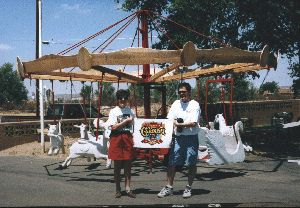
8.
Handcrank/110 Electric Carousel, Sold November 2021. Located in Castle
Rock, Washington. Soon to be used on December 11, 2021 at the Festival
of Lights. Formerly used at Wood Boat
Festival 1998 and 2012-2016, 2005-2011 DC Solar Powered at the Solar Living
Institute, Hopland,
California.
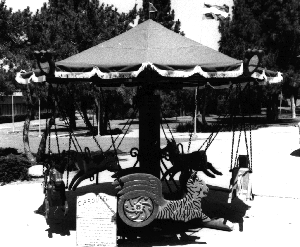
This is a 15 rider portable, foldable steel centerpole, carousel on a trailer base. Even though this
carousel was
not completed
and
installed until May 2005 at it's first long term public location, it
was conceived the same time as MGR #7 below and began turning in
1996-1997. It ran at the Port
Townsend Wood Boat Festival in 1998 and also was set-up on the grounds
of the local primary and elementary schools where it was accompanied by classroom presentations of carousel art,
design, and history.
From May 2005 to September 2011 it operated on solar electricity from PV
cells at the Solar Living
Institute in Hopland CA, in Mendocino County on US-101 halfway between
Port Townsend and Santa Barbara. In 2012 this carousel was completely
restored and up-graded to the latest carousel technologies
and styling in the Dentzel Carousel Company headquarter's workshops in
Port Townsend WA. It now runs smoothly and easily on either hand-crank
power or simple plug-in 110 volt electricity. The second weekend of
September 2012 it had an excellent four day run at the Port Townsend
Wood Boat Festival. It has also run again at the 2013 - 2016 Wood Boat
Festivals. In 2019 the carousel was featured at the Port Townsend THING festival.
M-G-R #8 is now permanently based in Castle Rock, Washington where
Matthew Wooldridge will be hosting it, his website is www.mezell.com
|
|
7. Bonnie and Steve Davis, McMinnville, Tennessee (1996)
Hand-cranked menagerie in the heartland of America.
Bonnie Davis
saw a
newspaper article on Bill Dentzel's people powered carousels and
decided to give him a call in 1995. She had an idea to operate a
portable carousel at various fairs and festivals happening throughout
the year in her Cumberland Plateau region of Tennessee. With the
help of Steve Taylor of Mobil Logic, Bill designed and built the 20'
diameter, 10 rider, portable carousel mechanism. Squeezing in a
carousel project, while continuing the more bread and butter task of
house carpentry, could only happen with more help, so Steve Arment of
Enterprise, Oregon was contacted to make the eight animals plus one
extra for display, Bill would make the swan chariot, all of the
component parts, hardware and scenic panels.
By late spring
1996 the
carousel was ready, this was after its beginning in Port Townsend and
completion in Carpinteria, CA. Because Bonnie and Steve were
professional sign painters they wanted to paint the whole carousel
themselves to save some money and have some special fun, this expedited
the project. With white primered animals loaded into the small
Datsun pick-up and the mechanism trailing behind, Zaryn, 12 years old,
and Bill drove out to New Mexico to meet
Bonnie and Steve at the halfway point between Carpinteria and
McMinneville, Tucumcari NM. At home Bonnie and Steve painted the
animals and scenic panels and put on their own special touches.
Soon they were operating it at venues throughout
the Cumberland region and continue to do so today.
|
|
6. Waveland, Mississippi Receives Carousel from the
Port Townsend Carousel Association (1991 2013)
Hands-on at all levels and ages, a community carousel
with a
new home in Mississippi.
In 1991, after
the
wonderful experience working with the kids at the Bay Area Discovery
Museum, Bill Dentzel ran the idea by Jim Toyne, the high school
vocational shop instructor,
and Bob Alford, the district superintendent, of building a similar
carousel in the Port Townsend high school shop; both were solidly
behind the project. Still, funds for materials and classroom
assistant time had to be raised and many other details worked out, most
crucial of which came to be the location of a site to set it up.
The idea
itself was
initiated in 1984 when the Port Townsend Carousel Association (a 501c-3 non-profit corporation) was
founded, but it wasn't until 1991 that the "build it in the school"
plan was devised. Still, as other projects regularly slipped
ahead in line, it took until 1995 to complete this wooden centerpole
carousel mechanism which has six animals and two double chariots.
During construction it was set-up to run at the Wooden Boat Festival more than once. With
Bill Dentzel's guidance, students in the Port Townsend schools made and
painted the whole carousel.
The
Port Townsend Carousel Association was unable to
secure a permanent installation site in Port Townsend or Jefferson
County and sadly the carousel parts spent silent years
in a storage shed. Then the opportunity arose for the
Port Townsend Carousel Association to donate the Carousel of the
Olympic Sea to the city of Waveland,
Mississippi as part of a local effort to help with the hurricane
Katrina reconstruction in the Gulf Coast. The citizens of
Waveland were excited to have this carousel, coincidentally there is an
antique Dentzel carousel further north in Meridian, Mississippi.
Although it took quite a while, with an oil spill and another hurricane
happening in the
midst of the reconstruction, they located a space late 2012
and began to look seriously into getting this historical carousel
set-up.
Late April
2013 Mike
and Jennifer Kopke arranged for Bill Dentzel, the carousel's designer and lead
builder, to make a visit to Waveland and show its new owners how
to set up and operate it. After an amazing four days and the
help of many Wavelanders the carousel was erected in the historic old
Waveland school house which had withstood the nastiest of hurricans for
many decades. The ride was celebrated and enjoyed by a band of adults
and one grandchild. Soon it will be prepared for general public use
with the low perimeter control fencing and a brass ring catching game.
This is
a major step forward in re-establishing Waveland as one of the most
attractive and pleasant small towns on the Gulf Coast. See these photos for more
details on this wonderful community event and project; one, two, three. Check out this Ground Zero Museum web page for details.
|
|
5. Davis Educational Foundation, Davis, California (1995)
Community, children, and carousel for school funding in
Davis's Central Park.
John Yates was
visiting
Sausalito in 1994 when he saw the foot-pedal powered carousel at the
Bay Area Discovery Museum. He was a founder and member of the
Davis Educational Foundation, local citizens dedicated to helping the
public schools do better with updated equipment and program
assistance. The possibility of using a carousel, ridden by
children, operated by specific classrooms as a project to raise money,
was presented to the group. In the sustainable tradition of
university-town Davis, the board of the DEF loved the idea. Of
course Bill liked the idea too, and agreed to orchestrate a similar
community painting program as was done in the big warehouse right next
to the BADM at Fort Baker in Sausalito. Again local
kids painted all of the parts during a big month long program held
at one of Davis's local elementary school's multipurpose room.
When finished
the
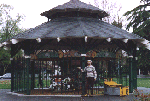
carousel sat under a beautiful pavilion
built by Chuck Roe and friends, one of the board members who was a
building contractor. The location is perfect, in the kids play
area at end of the town's central park right next to the beautifully
laid
out farmer's market stalls. Students manage the ticket sales, the
opening and closing of the ride, and of course are the power source for
making it go by using the foot-pedal mechanism located right next to
the entrance gate. Years of successful operation of this carousel
have brought tens of thousands of dollars to classroom and school
projects. Recently, while undergoing a much needed 10 year
overhaul, all of the animals were dismounted from the carousel.
During this period "Seymour" the seal was stolen. After a long
waiting period, hopes of a mysterious return, and no leads to his
whereabouts, a new seal had to be built, these are the
construction process photos. A 10 year anniversary
celebration took place in Davis September 2005.
Since
then the
carousel has continued to be operated by rotating groups of student
classes to raise classroom activity funds. Unfortunately the bunny was
stolen a few years ago and was just replaced by a memorial sea turtle.
A modification to the pole
hangers is being made to prevent any more animal thefts. Three photos
during June 2013's sea turtle installation; one, two, three.
Davis Schools Foundation, Davis Wiki.
|
|
4. Bay Area Discovery Museum, Sausalito, California to
Hunter's Tree Farm and Pumpkin Patch, Olympia, Washington (1991 2001)
Breaking into new design standards and a large
community
project.
This was the
carousel
design that made the biggest technological leaps since the first one
built in
Mexico 10 years earlier. In 1989 the program director of the Bay
Area Discovery Museum saw an article in the Carousel News and Trader
about Bill Dentzel's simple little carousels. She thought it
would be good for the children in the San Francisco Bay area to have an
opportunity to get involved with the making, or as it turned out,
painting, of their own carousel. After meetings, waiting periods,
fund raising and site planning, the day came late in 1990 that Bill was
given the go-ahead for this project. This time the mechanism
would be 18 feet in diameter (later similar models went up to 20'
diameter) and carry 10 riders instead of 5 by having two rows of
animals. Also, the animals would be hanging on poles going
through the body just in front of the saddle with a single chain
attached to the rear to balance the animal just like the horses
on the Dare carousel in Watch Hill, Rhode Island. Yet even with
these innovations the most radical development was yet to come, that
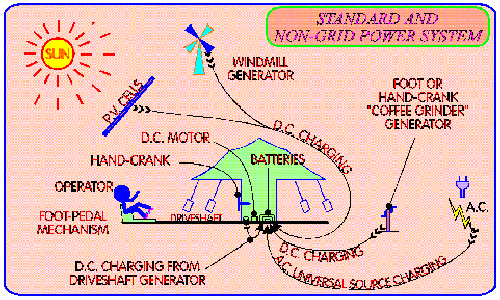
was the use of a recumbent seat with a foot-pedaling crank mechanism
attached with a long drive shaft at ground level to a vertical shaft
next to the centerpole powering the carousel's hub.
The pedaling
mechanism
was challenging to
design and build as it had to be solid, durable, weatherproof, and able
to accommodate children peddlers as well as adults comfortably;
ergonomics. Miraculously, working in the little Port Townsend
workshop right off the future 52nd Street trail, Bill created this
whole mechanism, completely filling the space of the shop to do
so. One final assembly and adjustment phase was undertaken in a
neighbor's rented RV garage before the mechanism, eight menagerie
animals and one double swan chariot was loaded into the utility trailer
and van for the ride south to Sausalito.
At the
children's
museum site it was a big
show with hundreds of
young artists working on all aspects of the
carousel, painting, stenciling, assembly of parts,
test-riding, and pedaling. The carousel operated there until 1999
when it was sold in order to make room for new exhibits. By fortunate
circumstances it was bought by the Port Townsend Carousel Association
to be used as an interim carousel for the summer of 2000 after which it
was sold to Hunter's
Tree Farm and Pumpkin Patch
(located at 7401 Yelm Highway SE,
Olympia WA). This caused a bit of a stir in some Port Townsend
circles and made for a few uncomfortable encounters between the
Port Townsend Carousel Association and city officials. Apparently
some powerful people in Port Townsend did not
want to see this type of activity occurring in their "Victorian
Seaport and Arts Community", although paradoxically the golden era of
carousel development
was the late 1800's, the same era that ushered in Port Townsend's
charming appearance. During this period dozens of carousel
companies
flourished in the USA and produced all manner of rides.
Nevertheless, the Sausalito Carousel, as it was called, is pedal
powered and operated seasonally at a very special kid's farm near
Olympia, WA until the beginning of the Covid pandemic. In April of 2022
it was sold to Maris Farms near Buckley, WA. Look for it operating
there in the near future.
|
|
3. North Star Tree Farm, Kelsey, California (1984)
In the foothills of the Sierra Nevada spins a
hand-cranked
menagerie.
This was
actually the
first carousel mechanism Bill Dentzel made in Port Townsend, it was
1984. The centerpole was the larger half of the differential used
in the sister city carousel which had the third member right-angled
gears. Bill, with his new little family, dragged it up to Port
Townsend in the back of a
U-Haul truck loaded with some tools and their worldly
possessions. This gear assembly made it possible to make a very
smooth and solid hand crank to drive the carousel's hub. As with
the previous two carousels, the carousel was
14 feet
in diameter and had four animals and a chariot all hanging
fore and aft by chains. The Sansom's of Kelsey, CA were visiting Port
Townsend in 1985 and saw this carousel temporarily operating at Pope
Marine Park for the weekend. They wanted to buy it for their tree
farm and pumpkin patch park. That is where it stands today in a
beautiful rustic setting at the center of the North
Star Tree Farm.
|
2. Jalapa, Nicaragua (1986)
Citizens sending a message of peace to Nicaragua.
After moving to Port
Townsend, Washington in 1983, Bill Dentzel got involved with a peace
group headed by Doug and Nancy Milholland forming the Jalapa/Port
Townsend Sister City Association. Their goal was to establish peace and
encourage friendly exchange between the regular citizens of the United
States and the people of war torn Nicaragua. A monument of
peace connected to both countries would be established. Projects
included; an improved water and sewage system, a city
park with a play structure and a carousel.
The carousel animals were built by Bill while attending the École de
Sculpture sur Bois as a guest instructor in St. Jean-Port Joli, Québec,
in 1982, the rope-pull style mechanism was built in Santa Barbara early
in 1983, in 1985 Marion Dentzel bought the machine and donated it to
the sister
city group. In 1986 a group of volunteers from Port Townsend WA
and Boulder CO went down to Jalapa with a truck load of equipment and
supplies (carousel pre-shipment set-up) and
worked with the Jalapan people to complete these projects. In Port
Townsend several big fund raising dances and auctions were organized
along with other informative presentations to pay for some of the
transportation and goods.
Note: In 2004, 18
years
later, Zaryn Dentzel was able to locate and visit this small regional
agricultural village in the northern hills near the Honduran border
while making a free-trade and co-op coffee research trip. It was
a sad story he heard and had to relay back to
Village Carousel Project HQ in Port Townsend. During the war with
the contras the carousel was dismantled and stored by the villagers to
protect it. Certain parts were "borrowed" (chains, etc.) for
other uses which made it impossible to re-erect. Now the animals
are scattered in different houses in the area and the carousel awaits a
restoration crew!
1.
Ochusjop, Chiapas, Mexico (1981)
First carousel in the remote hinterlands of Chiapas, Mexico.
In 1980 Bill Dentzel was
living in San Cristobal de las Casas, Chiapas, Mexico, a highland
colonial city in the midst of several distinctive Mayan villages. In
SCLC Bill was privileged to be able to learn the art of turning
tropical hardwoods on the lathe to make bowls under the instruction of
renowned Venezuelan artist Anna Maria Olalde. It was through Ms.
Olalde's suggestion and insistance that Bill broke away from the
antique carousel
restoration routine he had when working in California and wooden boat
restoration in Denmark and Malta. With Anna's help, Bill approached the
Casa de la
Culture y Bellas Artes in San Cristobal and discussed the possibilities
of building a carousel in Chiapas. A simple preliminary
sketch was given to "Memo" director of Bellas Artes and "el
Archetecto" (the head of F.I.O.S.C.E.R.,
Fidicomiso para Obras Sociales de Caneros de Escarsos Recursos, in Chiapas, a government trust
fund for social projects for sugar cane workers of scarce resources,
funded by the sugar tax). In a surprisingly short period of time, three
months, the plan was approved at F.I.O.S.E.R. HQ in Mexico City and
Bill was given the go-ahead to work with the local people in Chiapas to
build this carousel.
The five rider
carousel was
built in SCLC in the Spring of 1981, mostly in the workshop area of
Kiki and Gabriel Saurez at the La Quinta household. Local Spanish
pinewood, regularly used for house construction and furniture, was
stacked like tee-pees to dry in la Quinta courtyard. With a plank
workbench and a handful of simple tools the animals were
cutout and carved into shape. Don Trini, the local welder and
repairman extraordinaire, was the major collaborator for the rotating
mechanism's construction. The hub and spindle of a large salvaged truck
rear-end was used for the main bearing. The hub
mechanism was given thick steel straps for mounting onto a wooden pole
or
tree trunk, as it turned out to be. Several talented SCLC artists
joined
in the effort to paint the animals at La Quinta. A large celebration
party followed the completion of the carousel's parts. After this, the
incredible journey was made to Ochuxsop (via Comitan and through Tzmol)
in a jeep-like 1971 Volvo wagon.
The village of
Ochusjop, with no real roads, was built on an ancient hill site
overlooking the
"zona cañeros" and a large subtropical canyon. The friendly people of
Ochusjop spoke their indigenous language and some Spanish. After making
camp in a school room, in short order a thick cedar tree was located,
cut down and used as the center pole. In their typical thorough
and natural style the village work team dug a deep pit at the center of
the location, lowered the huge butt of the cedar tree down into it and
locked the pole into position with huge boulders and tightly packed
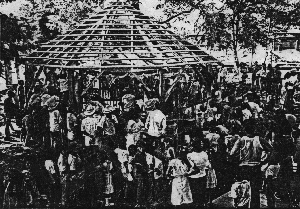
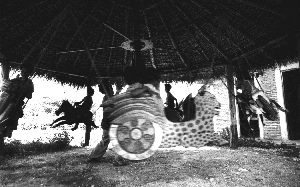
clay dirt. After that a stout circular palm palapa was expertly
built over the centerpole on the schoolyard site and the carousel (horse view) was fitted and assembled there.
During this time, the women of the village were making hundreds of
green leaf wrapped tamales (cooked in huge outdoor ground-pits) and
other
local treats. On the day of the inauguration hundreds of people came to
Ochuxsop on foot and horseback from the whole surrounding region.
The big fiesta happened, the carousel (chariot
view) was used to its maximum heavy duty specifications, often
times carrying five riders PER animal with two or three kids inside
pulling the rope to make the carousel spin with another two or three
who crawled up into the upper mechanism sweep arms to hold on for the
ride, in other words, fully used.
Amazingly, a day
later,
toward the end of the fiesta, the sky started raining fine white
flakes, they weren't snow. The buildings and land slowly became fuzzy
white with ash, the sky was a strange grayish pink, the atmosphere was
warm and silent. Later it was found out that all of the roads to
San Cristobal were closed because the volcano "el Chichon" had
exploded. The carousel crew was obliged to stay on an additional week
in Ochuxsop because of this, eating scores more of the big fat tamales,
beans, rice, eggs, and an occasional bit of chicken.
During the extended
stay
many small matters were presented by the villagers, some were taken
care of
such as fixing small gasoline engines and examining water problems.
Water was the continual topic of discussion among the elders. Even
though there was a raging river flowing through the bluegreen canyon at
the base of the rocky and dry hill, water still had to be hauled over a
mile up a steep trail to the village in wooden barrels on the backs of
donkeys. Leading the donkeys up the trail, and usually carrying a
barrel or can of water also were the village's children, this was a
daily chore, more regular than school.
The carousel crew
rode
horses down to this river and were amazed at its waterfalls and large
shaded pools held up by mineral dams. Of course we all went swimming,
the water was refreshing and mild, no bugs. Soon after this soujourn
news of the
roads opening up arrived, the trip back to the ash buried city of San
Cristobal had to take place. The scene there was of devastation,
surrealistic and sad. In all directions one saw that from 6 to 24
inches of
extremely fine gray powder had settled, reaching into every little
crack and interior space. The carousel adventure came to a rapid close,
the crew went into survival mode. Still, the magic and joy experienced
with the people of Ochusjop assured "Don Guillermo" that making simple
carousels in remote communities for children to ride was a wonderful
life's pursuit.
Note:
In 2004, 23
years
later, Zaryn Dentzel, Bill's older son, on a coffee research trip to
Central America, was able to loop north to Comitan and San
Cristobal. With directions from his dad, he was able to reach
Ochusjop, still very isolated and off the beaten track. The
carousel was still operating in the school yard near the town
square. The people had stories of his dad and the days of
celebration when setting it up. The main question was, when is
Don Guillermo coming back? The answer is, a.s.a.p., maybe late in
2015 if lucky. (Or how about 2016?) Note: The reunion actually happened
in February 2017 and was a great joy for all, carousel still proudly
running. Pavilion repaired and animals painted!
|